Chemical equilibrium and routes to K
After midterm · Session 5 of 6 · 180 minutes
30 September 2026
Session outcome
Reconcile independent thermodynamic routes to K and then solve composition.
Before class: Review formation Gibbs energies, reaction enthalpy/entropy and integration of heat capacity.
The 180-minute class
| In class | Minutes |
|---|---|
| Recall and prediction | 10 |
| Concepts and derivation | 45 |
| Worked example | 30 |
| Break | 10 |
| Instructor lab demonstration | 25 |
| Guided student exploration | 35 |
| Discussion and interpretation | 15 |
| Exit question and independent task | 10 |
Reaction equilibrium changes composition
n_i=n_{i,0}+\nu_i\xi \Delta_rG=\sum_i\nu_i\mu_i=\Delta_rG^\circ+RT\ln Q
Stoichiometric coefficients are negative for reactants and positive for products. At an interior equilibrium, ΔrG=0.
K and Q have different roles
\ln K=-\frac{\Delta_rG^\circ}{RT},\qquad Q=\prod_i a_i^{\nu_i}
K is tied to T and the fixed reaction/standard-state convention. Q describes the supplied state.
Q=K is an equilibrium condition, not an identity for every measured composition.
Standard states keep K dimensionless
| Phase | Activity used |
|---|---|
| Gas | φᵢ yᵢ P/p° |
| Solute, molarity standard | γᵢ cᵢ/c° |
| Liquid solution | γᵢ xᵢ |
| Present pure solid/liquid | 1 |
Formation data and activities must use matching phases and standards.
Several routes to standard Gibbs energy
- Supplied ΔrG° at the evaluation T.
- Formation properties: ΔrG°=ΣνᵢΔfGᵢ°.
- Reaction enthalpy and entropy: ΔrG°=ΔrH°−TΔrS°.
- Reference K with integrated temperature dependence.
- Equilibrium activities, only when equilibrium is supported.
Independent inputs can disagree; the lab preserves the disagreement.
A reference-state check
Lab 12 synthetic A₂ ⇌ 2A at 350 K uses ΔrG°=−4.000 kJ/mol.
\ln K=\frac{4000}{R(350)}=1.37454,\qquad K\approx3.95326
With ΔrH°=50.000 kJ/mol and ΔrS°=54000/350 J mol⁻¹ K⁻¹, the H−TS route gives the same value.
Constant-enthalpy van ’t Hoff relation
\frac{d\ln K}{dT}=\frac{\Delta_rH^\circ(T)}{RT^2}
With constant ΔrH° over the stated interval, \ln\frac{K(T)}{K(T_r)}=\frac{\Delta_rH_r^\circ}{R}\left(\frac1{T_r}-\frac1T\right)
An endothermic reaction has increasing K with T in this approximation.
Constant heat-capacity correction
\Delta_rH^\circ(T)=\Delta_rH_r^\circ+\Delta_rC_p^\circ(T-T_r) \Delta_rS^\circ(T)=\Delta_rS_r^\circ+\Delta_rC_p^\circ\ln(T/T_r)
The integrated ln K adds \frac{\Delta_rC_p^\circ}{R}\left[\ln(T/T_r)+T_r/T-1\right]
to the constant-enthalpy expression.
Reference consistency and temperature applicability
Changing only Kref while holding reference H and S fixed creates two independent anchors that may disagree.
Point ΔG° and formation-energy data are unavailable away from their supplied T unless an explicit temperature model exists.
Keeping ln K avoids false zeros or infinities from exponent underflow/overflow.
Equilibrium extent and pressure
For a neutral ideal-gas reaction, Q(\xi)=\prod_i\left[y_i(\xi)P/p^\circ\right]^{\nu_i}
Solve lnQ(ξ)−lnK=0 within nonnegative mole amounts. Pressure changes Q and equilibrium composition, not standard K at fixed T.
Adding inert gas at fixed total pressure differs from adding it at fixed volume.
Gibbs energy along extent
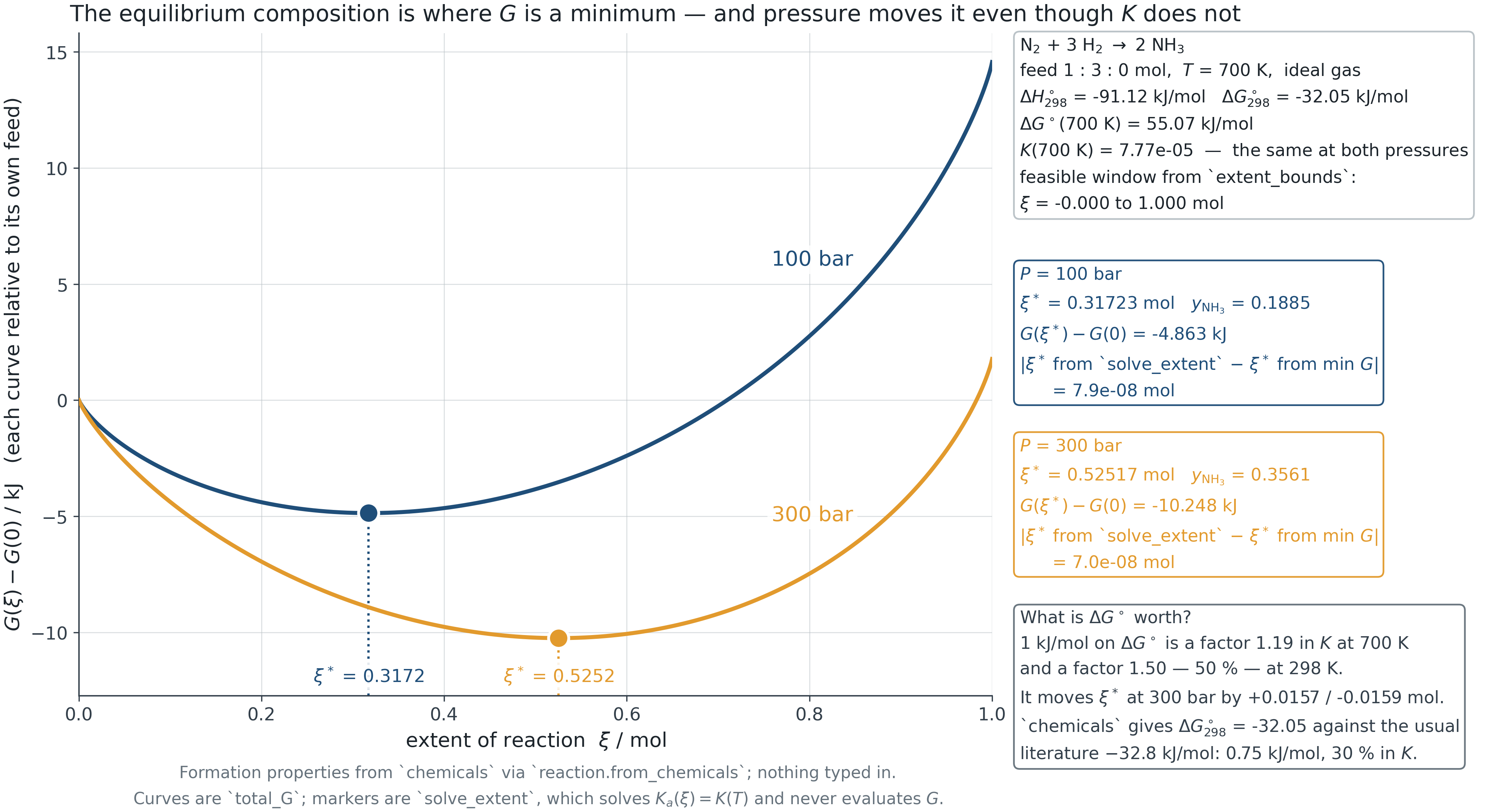
Class demonstration · Lab 12
- Compare all applicable routes at the synthetic reference T.
- Change T and compare ΔCp and constant-property results.
- Change pressure at fixed T; inspect extent and atom balances.
- Export the study and restore it to repeat the calculation.
Guided exploration · 35 minutes
Choose one temperature change and one pressure change.
Keep a table of lnK, Q, reaction direction and equilibrium extent. Explain which quantities change for each intervention.
Independently check one atom balance and one H−TS or van ’t Hoff calculation.
Reaction scaling changes K
Reversing the reaction changes lnK to −lnK. Multiplying every coefficient by c changes lnK to c lnK.
Formation sums, reaction H, S, Cp and direct ΔG must transform on the same basis.
A numerical K without a written reaction is incomplete information.
Exit question
At the same temperature, pressure increases and equilibrium conversion changes.
Does this mean the equilibrium constant changed?
What additional information is needed before using one ΔG° value at a second temperature?
Independent practice · suggested 60–90 minutes
Compare constant-property and heat-capacity routes; report ln K, Q and one extent/material-balance check.
Retain the calculator export, your worksheet, a comparison plot/table and one independent check. State an assumption that limits your conclusion.
Use the core labs on the learning path. Optional extensions are additional work.
References and further study
Module reference deck · Lab sources and equations
IUPAC: standard electromotive force and standard equilibrium constant.
Synthetic worked examples illustrate calculations; they are not evidence of real-system accuracy.