Appendix: Electrochemical equilibrium
Session 6 · optional reference
30 September 2026
Optional reference material
Return to the 12-slide classroom deck.
Use these details when a question from your investigation needs them. They are outside the required 45–60 minute practice.
Choose one extension: scale the balanced reaction and electron count, examine activity corrections within the supported model, or explain why equilibrium voltage differs from voltage under load.
Chemical and electrochemical potential
For an ion of charge number zᵢ, \tilde\mu_i=\mu_i+z_iF\varphi
Chemical and electrical contributions enter the driving force. The cell potential connects that driving force to electrical work under reversible conditions.
Electron and charge bookkeeping
A reduction consuming n electrons has \sum_{species}\nu_i z_i+n=0
Lab 13 excludes electrons from the species table and adds their charge using the entered n. It checks the declared atom counts independently.
Matching electron counts uses their least common multiple.
Potential, Gibbs energy and K
\Delta_rG^\circ=-nFE^\circ,\qquad \ln K=\frac{nFE^\circ}{RT} \Delta_rG=-nFE
Positive E favors the written cell reaction. At complete-cell equilibrium Q=K and E=0.
These relationships refer to the written reaction basis.
Activities remain separate by compartment
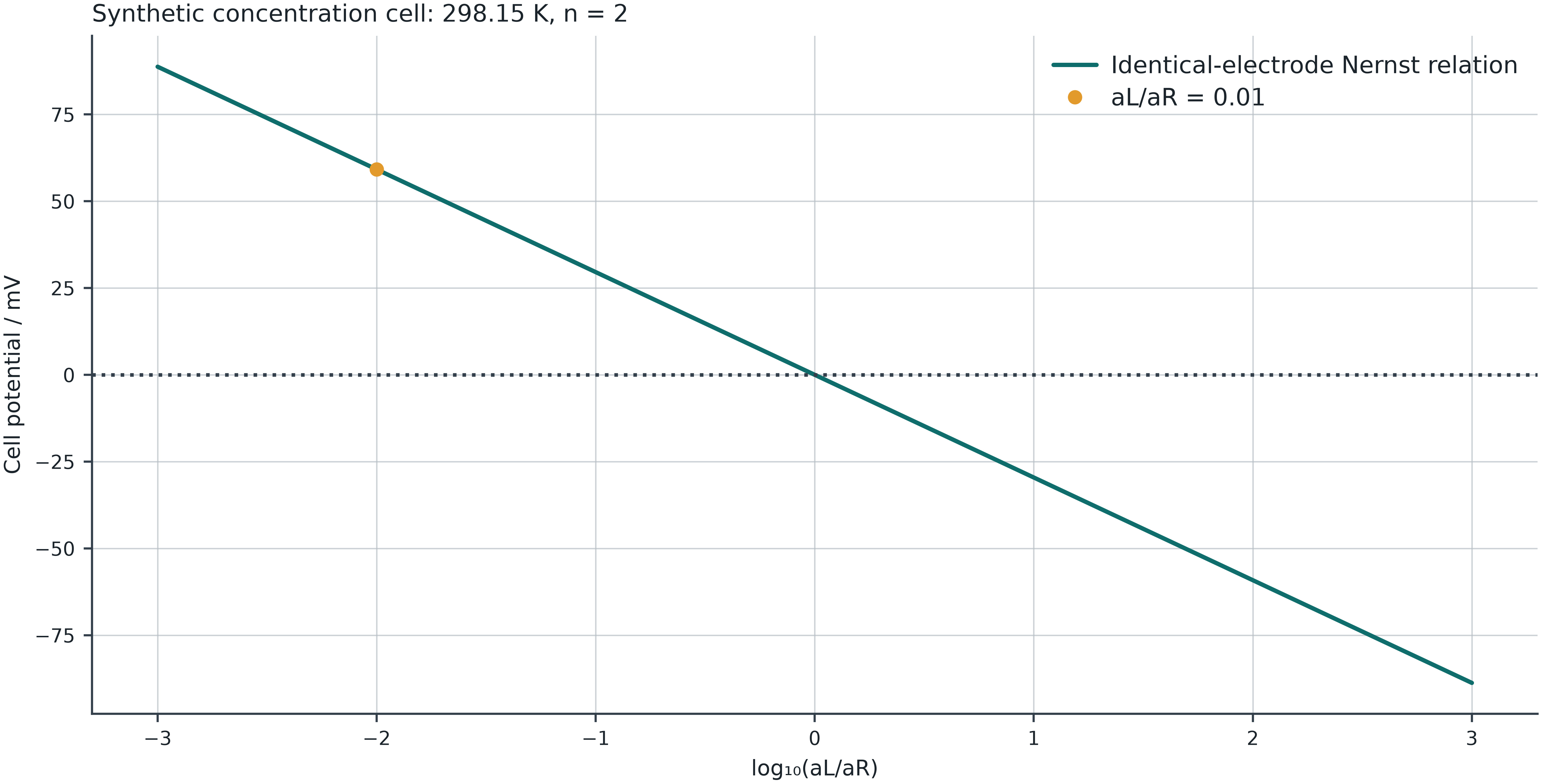
For identical M²⁺/M electrodes, M_L+M_R^{2+}\rightleftharpoons M_L^{2+}+M_R Q=\frac{a(M_L^{2+})}{a(M_R^{2+})},\qquad E^\circ=0
The same ion in different compartments cannot be canceled when its activities differ. Pure present solids have unit activity.
Nernst sensitivity to an activity ratio
Concentration is not activity
For a molarity standard, a_i=\gamma_i c_i/c^\circ
Changing γ changes the activity ratio even if both concentrations are unchanged. A molality-based γ cannot be inserted into this equation without a consistent conversion.
Individual-ion activity conventions and reference states must match the potential data.
Reaction scaling leaves E unchanged
Multiply the full cell reaction by two:
| Quantity | Transformation |
|---|---|
| n, ΔrG°, ΔrG | Multiply by 2 |
| lnK, lnQ | Multiply by 2 |
| K, Q | Square |
| E°, E | Unchanged |
Potential is a driving force per unit charge, not a reaction energy.
Equilibrium voltage and operating voltage
The lab assumes reversible electrodes and zero liquid-junction potential.
It does not calculate current, kinetic overpotential, ohmic loss, mass-transfer limits or full electrolyte speciation.
A nonzero open-circuit potential is compatible with local electrode equilibrium; complete cell-reaction equilibrium gives E=0.
Sources and further reading
Module reference deck · Lab assumptions and sources
The worked examples use synthetic inputs. Each lab states its supported models and validity limits.