Battery papers: article types
Session 3 · 21 October 2026
All sessions · Slides · Worksheet 3
These papers illustrate five article types. The in-class examples use Zhu, Tomaszewska, Nie, Edge and Stroebl. Severson is optional further reading. Identify the main contribution, the role of the evidence and the publisher’s category. The one-hour class uses the figures as examples of those purposes.
Research article, shown in class: Zhu et al. (2022)
Data-driven capacity estimation of commercial lithium-ion batteries from voltage relaxation
Nature Communications. Publisher category: Article.
DOI: 10.1038/s41467-022-29837-w · Article / access page
Reading task: What new method does the paper contribute? How does Figure 4c support that claim? Give a one-sentence reason for the research-article format.
Open access, CC BY 4.0. Slide 4 reproduces panel 4c with the original axes, inset and density scale.
Research article: Severson et al. (2019)
Data-driven prediction of battery cycle life before capacity degradation
Nature Energy. Publisher category: Article.
DOI: 10.1038/s41560-019-0356-8 · Article / access page
Reading task: Identify the main scientific contribution. Explain why releasing data does not by itself change the article type.
Publisher abstract and article page. Full text may require institutional access.
Review: Tomaszewska et al. (2019)
Lithium-ion battery fast charging: A review
eTransportation. Publisher category: Review article.
DOI: 10.1016/j.etran.2019.100011 · Article / access page
Reading task: What literature does the review synthesize? How do its schematic profiles organize that literature?
Open published version in the authors’ institutional repository.
Communication: Nie et al. (2021)
Improving high rate cycling limitations of thick sintered battery electrodes by mitigating molecular transport limitations through modifying electrode microstructure and electrolyte conductivity
Molecular Systems Design & Engineering. Publisher category: Communication.
DOI: 10.1039/D1ME00082A · Article / access page
Reading task: Confirm the publisher label. What makes the contribution focused, and which format requirements would you check at the intended journal?
Publisher page and a linked author manuscript. If a PDF link is unavailable, use the publisher page or institutional access.
Perspective: Edge et al. (2021)
Lithium ion battery degradation: what you need to know
Physical Chemistry Chemical Physics. Publisher category: Perspective.
DOI: 10.1039/D1CP00359C · Article / access page
Reading task: Identify the organizing interpretation or framework. Explain why the publisher labels this a Perspective.
Open access, CC BY 3.0. The publisher’s label is Perspective despite the broad title.
Data paper: Stroebl et al. (2024)
A multi-stage lithium-ion battery aging dataset using various experimental design methodologies
Scientific Data. Publisher category: Data Descriptor.
DOI: 10.1038/s41597-024-03859-z · Article / access page
Reading task: Locate Data Records and Technical Validation. Explain how these sections support reuse as the main contribution.
Open access article. The Data Records section links the data repository.
Original figures used in the slides
- Slide 4: Zhu et al., Figure 4c. XGBoost capacity estimates versus measured capacity. Panel extracted with its inset and density scale. CC BY 4.0.
- Slide 5: Tomaszewska et al., Figure 8a,c. Schematic CC-CV and multistage CC-CV profiles. Panels rearranged with the original shared legend. These are conceptual profiles, not measured performance curves. CC BY 4.0.
- Slide 7: Edge et al., Figure 9. Enlarged detail of the outcome region; upstream pathways are outside the crop. Open the complete original map. CC BY 3.0.
- Slide 8: Stroebl et al., Figure 8b,d. Stage 1 cycle-aging capacity and DCIR curves. Panels rearranged with the original shared temperature legend. The legend’s 10 °C entry belongs to calendar aging, not these cycle-aging panels. CC BY 4.0.
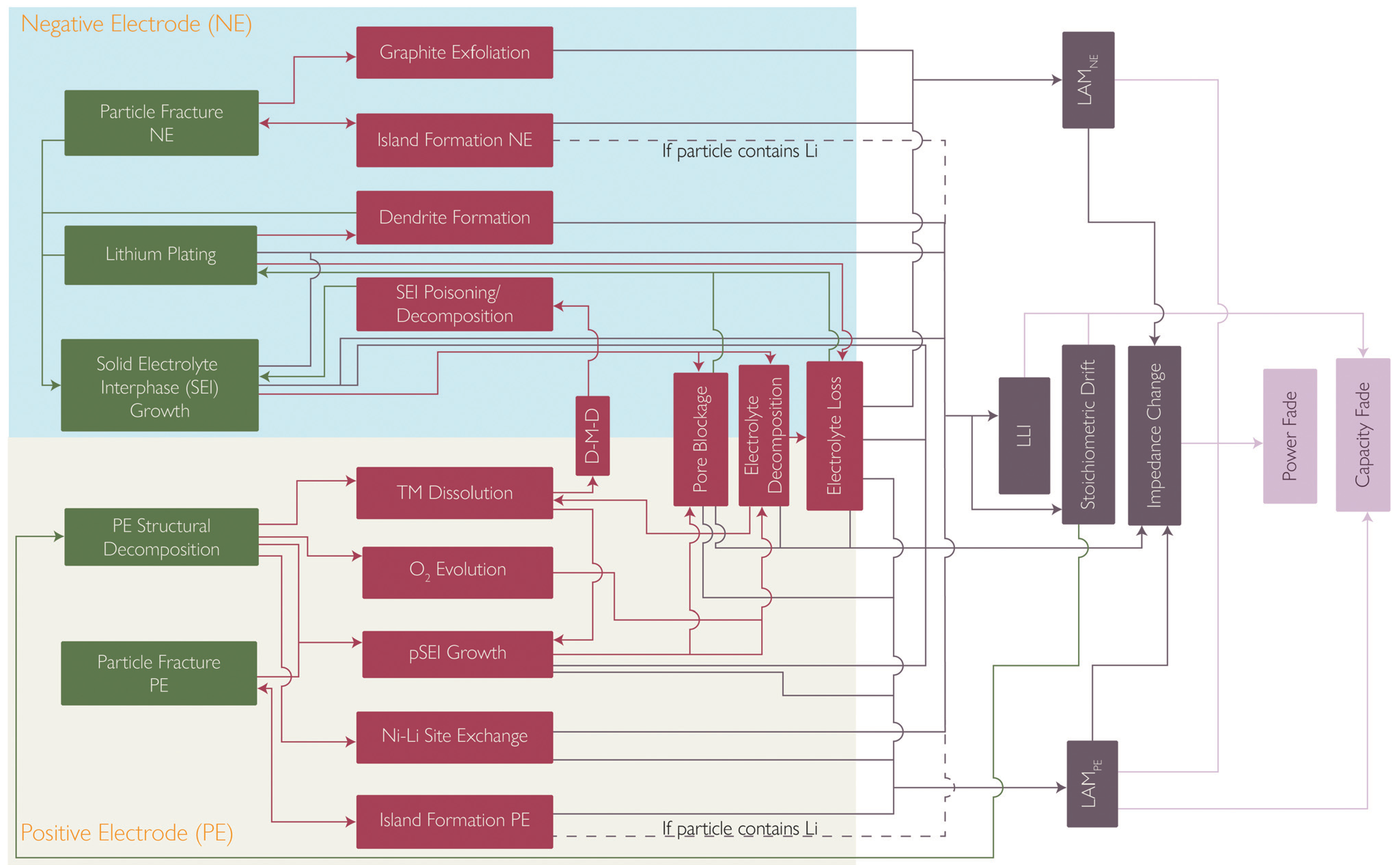
Original colors and data are retained. The linked figures can be opened at full size from each slide. The figure’s role in the argument helps explain the article type. Its appearance alone does not determine the category.
Choosing a format for your manuscript
State what your manuscript contributes and who would use it. Choose a format that fits the evidence available, then check the target journal’s definition. If the work is still planned, a proposal describes that plan. The class treats this as a short boundary case.