Appendix: Chemical equilibrium and routes to K
Session 5 · optional reference
30 September 2026
Optional reference material
Return to the 12-slide classroom deck.
Use these details when a question from your investigation needs them. They are outside the required 45–60 minute practice.
Choose one extension: vary temperature with and without a heat-capacity correction, reverse the reaction, or scale its coefficients consistently.
Reaction equilibrium changes composition
n_i=n_{i,0}+\nu_i\xi \Delta_rG=\sum_i\nu_i\mu_i=\Delta_rG^\circ+RT\ln Q
Stoichiometric coefficients are negative for reactants and positive for products. At an interior equilibrium, ΔrG=0.
Standard states keep K dimensionless
| Phase | Activity used |
|---|---|
| Gas | φᵢ yᵢ P/p° |
| Solute, molarity standard | γᵢ cᵢ/c° |
| Liquid solution | γᵢ xᵢ |
| Present pure solid/liquid | 1 |
Formation data and activities must use matching phases and standards.
Constant-enthalpy van ’t Hoff relation
\frac{d\ln K}{dT}=\frac{\Delta_rH^\circ(T)}{RT^2}
With constant ΔrH° over the stated interval, \ln\frac{K(T)}{K(T_r)}=\frac{\Delta_rH_r^\circ}{R}\left(\frac1{T_r}-\frac1T\right)
An endothermic reaction has increasing K with T in this approximation.
Constant heat-capacity correction
\Delta_rH^\circ(T)=\Delta_rH_r^\circ+\Delta_rC_p^\circ(T-T_r) \Delta_rS^\circ(T)=\Delta_rS_r^\circ+\Delta_rC_p^\circ\ln(T/T_r)
The integrated ln K adds \frac{\Delta_rC_p^\circ}{R}\left[\ln(T/T_r)+T_r/T-1\right]
to the constant-enthalpy expression.
Reference consistency and temperature applicability
Changing only Kref while holding reference H and S fixed creates two independent anchors that may disagree.
Point ΔG° and formation-energy data are unavailable away from their supplied T unless an explicit temperature model exists.
Keeping ln K avoids false zeros or infinities from exponent underflow/overflow.
Equilibrium extent and pressure
For a neutral ideal-gas reaction, Q(\xi)=\prod_i\left[y_i(\xi)P/p^\circ\right]^{\nu_i}
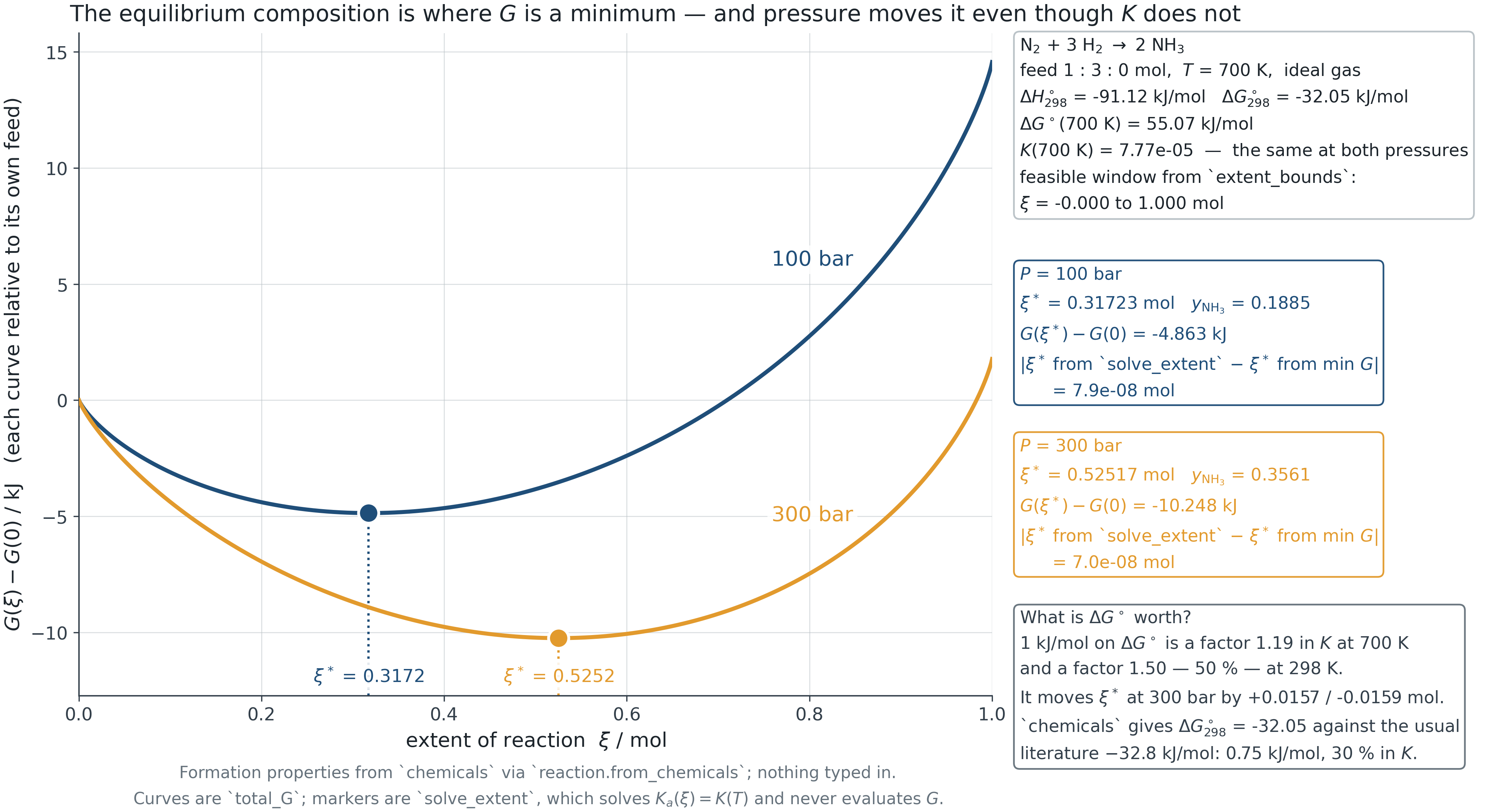
Solve lnQ(ξ)−lnK=0 within nonnegative mole amounts. Pressure changes Q and equilibrium composition, not standard K at fixed T.
Adding inert gas at fixed total pressure differs from adding it at fixed volume.
Gibbs energy along extent
Reaction scaling changes K
Reversing the reaction changes lnK to −lnK. Multiplying every coefficient by c changes lnK to c lnK.
Formation sums, reaction H, S, Cp and direct ΔG must transform on the same basis.
A numerical K without a written reaction is incomplete information.
Sources and further reading
Module reference deck · Lab assumptions and sources
The worked examples use synthetic inputs. Each lab states its supported models and validity limits.