Appendix: Liquid stability, LLE and VLLE
Session 3 · optional reference
30 September 2026
Optional reference material
Return to the 12-slide classroom deck.
Use these details when a question from your investigation needs them. They are outside the required 45–60 minute practice.
Choose one extension: NRTL tie-line fitting in Lab 05, paired bootstrap from independent replicates, or feasible three-phase amounts in Lab 06.
Binodal and spinodal
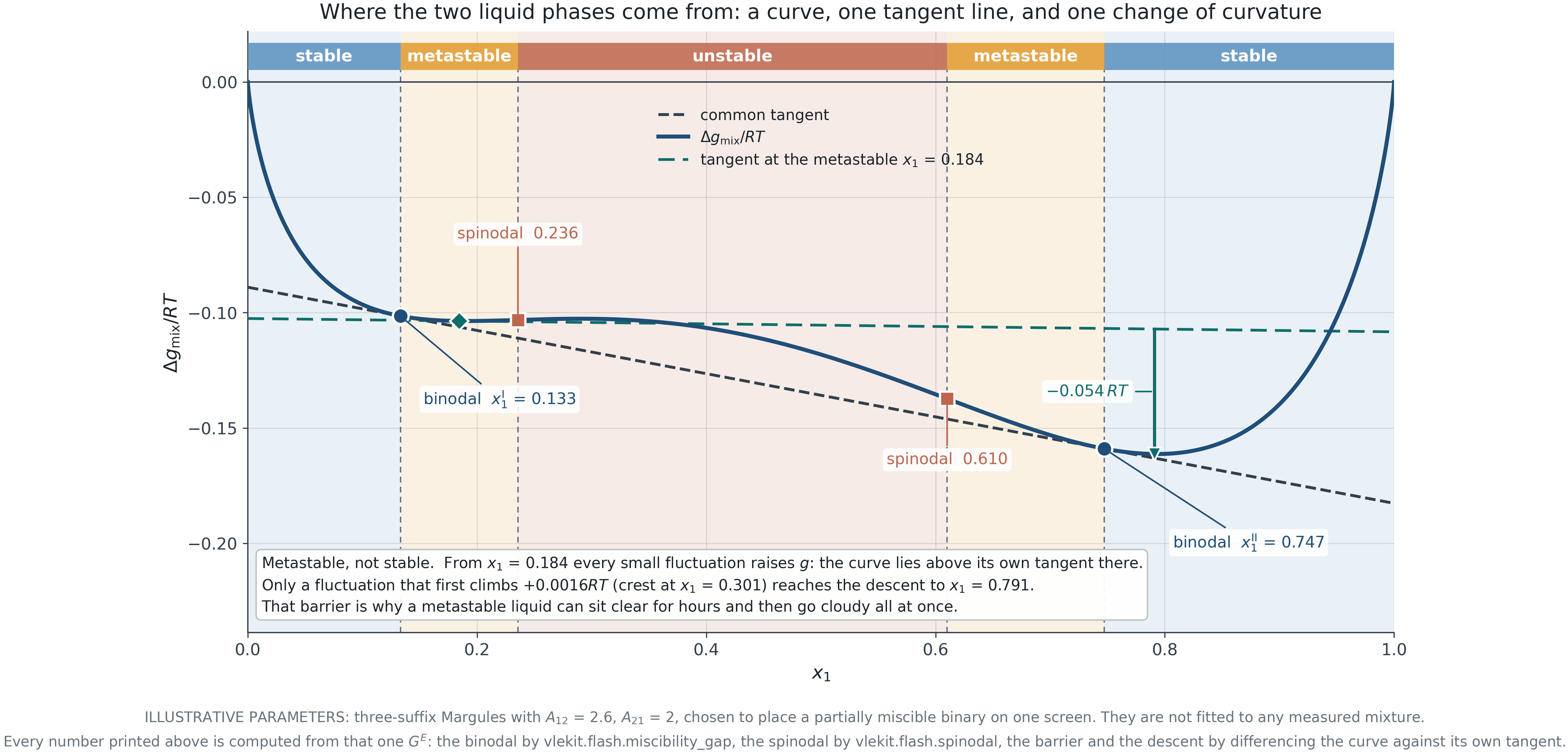
Tangent-plane distance
For a trial composition w relative to reference z, TPD(w;z)=g(w)-g(z)-g'(z)(w-z)
A negative value identifies a Gibbs-energy-lowering perturbation. Local curvature examines only the neighborhood of z.
Lab 04 evaluates the binary model; it is not a general multicomponent TPD package.
Model shape and liquid splitting
Positive activity deviations alone do not guarantee LLE. The mixing Gibbs-energy shape must support a split.
The labs include Margules and NRTL options with different shapes. Standard Wilson behavior is discussed in the reference deck, not implemented as an LLE solver here.
LLE fitting uses different evidence
Tie-line data constrain the coexistence compositions. Fitting must reproduce distinct phases and a supported common tangent.
A small tie-line error at one T does not establish a unique parameter set or a temperature law.
Lab 05 retains the input observations and checks stability of the fitted result.
Vapor–liquid–liquid coexistence
\hat f_i^V=\hat f_i^{L\alpha}=\hat f_i^{L\beta}
For a binary nonreacting system with three phases, the phase rule gives one intensive degree of freedom before imposing T or P.
Phase compositions and phase amounts are different unknowns. Specifying T and P does not always uniquely determine all amounts.
Three phase amounts can form a family
Given three fixed binary phase compositions, f_\alpha+f_\beta+f_V=1 z_1=f_\alpha x_1^\alpha+f_\beta x_1^\beta+f_Vy_1
There are two independent constraints on three fractions. Nonnegativity bounds the feasible family. Another independent extensive constraint may select a member.
VLLE extension
Compare the supported liquid and vapor states. Move within the admissible phase-fraction family and verify the overall balance.
Identify a state where the vapor fraction is constrained by nonnegativity. Explain why equal fugacities alone cannot determine every fraction.
Where the model can be reused
A fitted liquid model needs a matching component order, parameter convention and temperature before reuse.
VLE also requires pure-component vapor pressures and a vapor model. LLE experimental pressure is not a vapor-pressure correlation.
A new phase calculation brings new assumptions and validation needs.
Sources and further reading
Module reference deck · Lab assumptions and sources
The worked examples use synthetic inputs. Each lab states its supported models and validity limits.