10 An idealized vessel schedule
Problem 10 | Batch Production with Sequence-Dependent Cleaning | Level 1: Guided problem
10.1 Problem Statement
Four nonpreemptive batches must be processed on one vessel. The vessel is clean and available at time zero. A release time is the earliest processing start, not the earliest cleaning start. Cleaning may occur while the next batch awaits release. Initial and final cleaning times are zero.
| Job | Processing time (h) | Release (h) | Due time (h) | Tardiness charge (USD/h) |
|---|---|---|---|---|
| A1 | 2 | 0 | 6 | 4 |
| A2 | 3 | 2 | 12 | 2 |
| B1 | 2 | 1 | 7 | 5 |
| C1 | 4 | 0 | 14 | 1 |
Cleaning times depend on product family, denoted by the first letter of the job name:
| From / to | A | B | C |
|---|---|---|---|
| A | 0 | 1 | 2 |
| B | 3 | 0 | 1 |
| C | 1 | 2 | 0 |
All cleaning times are in hours. Normal shift length is 12 h. For the reference models, processing starts lie between 0 and 30 h and the final completion time between 0 and 40 h.
Your task. Ignore cleaning times. Minimize the time at which all four jobs finish while respecting release times. Due times are reported but are not restrictions in this first model.
10.1.1 Before you code
Calculate the total processing time as a lower bound. Can the jobs be ordered to attain it without waiting for a release?
10.1.2 Deliverables
- Define decision variables, units, objective, and constraints. State which data and assumptions are fixed.
- Predict one feature of the solution and explain why it should occur.
- Build and solve a Pyomo model. Check balances and bounds independently.
- Interpret the result and investigate the follow-up question below. For an open-ended challenge, state and defend your chosen policy separately from the reference solution.
10.2 Model Formulation
Let \(x_{ij}=1\) if job \(j\) immediately follows \(i\), with dummy nodes start and end. Let \(s_j\) be processing start and \(C_{max}\) final completion. Each job has exactly one predecessor and one successor; start has one outgoing arc and end one incoming arc. There is no direct start-end arc.
For job-to-job arcs, \[s_j\ge s_i+p_i+t_{ij}-M(1-x_{ij}),\qquad s_j\ge r_j.\] For job-to-end arcs, replace \(s_j\) by \(C_{max}\) and set cleaning to zero. Use \(M=50\) h. This is sufficient because starts are at most 30 h, processing at most 4 h, and cleaning at most 3 h; a deactivated inequality is redundant. Positive processing times rule out disconnected directed cycles: summing the time inequalities around a cycle would imply a strictly positive duration is at most zero.
Set \(t_{ij}=0\) for every arc and minimize \(C_{max}\). Due times do not enter the objective, so a makespan-optimal sequence can still deliver some jobs late. Multiple optimal sequences are possible.
10.3 Pyomo Implementation
The code below is the model-building portion of models/scheduling.py. The level argument selects this problem’s assumptions. Run the complete module from the source bundle to reproduce the solution, including its independent checks:
~/.venvs/optim/bin/python -m models.scheduling 1"""Single-vessel sequencing with release times and directed cleaning."""
import itertools
import pyomo.environ as pyo
from models.common import value
JOBS = ["A1", "A2", "B1", "C1"]
DURATION = {"A1": 2, "A2": 3, "B1": 2, "C1": 4} # h
RELEASE = {"A1": 0, "A2": 2, "B1": 1, "C1": 0}
DUE = {"A1": 6, "A2": 12, "B1": 7, "C1": 14}
WEIGHT = {"A1": 4, "A2": 2, "B1": 5, "C1": 1} # USD/(h of tardiness)
CLEAN = {
("A", "B"): 1,
("A", "C"): 2,
("B", "A"): 3,
("B", "C"): 1,
("C", "A"): 1,
("C", "B"): 2,
}
def cleaning(i, j, level):
return 0 if level == 1 or i == "start" or j == "end" else CLEAN.get((i[0], j[0]), 0)
def build(level):
arcs = [
(i, j)
for i in ["start"] + JOBS
for j in JOBS + ["end"]
if i != j and (i, j) != ("start", "end")
]
m = pyo.ConcreteModel(name="Batch vessel schedule")
m.J = pyo.Set(initialize=JOBS)
m.A = pyo.Set(initialize=arcs, dimen=2)
m.x = pyo.Var(m.A, domain=pyo.Binary)
m.s = pyo.Var(m.J, bounds=(0, 30))
m.finish = pyo.Var(bounds=(0, 40))
m.out = pyo.Constraint(
["start"] + JOBS,
rule=lambda m, i: sum(m.x[i, j] for a, j in m.A if a == i) == 1,
)
m.inc = pyo.Constraint(
JOBS + ["end"], rule=lambda m, j: sum(m.x[i, j] for i, b in m.A if b == j) == 1
)
m.release = pyo.Constraint(m.J, rule=lambda m, j: m.s[j] >= RELEASE[j])
m.time = pyo.ConstraintList()
for i, j in arcs:
if i == "start":
continue
target = m.finish if j == "end" else m.s[j]
m.time.add(
target
>= m.s[i] + DURATION[i] + cleaning(i, j, level) - 50 * (1 - m.x[i, j])
)
m.tardy = pyo.Var(m.J, domain=pyo.NonNegativeReals)
m.late = pyo.Constraint(
m.J, rule=lambda m, j: m.tardy[j] >= m.s[j] + DURATION[j] - DUE[j]
)
m.overtime = pyo.Var(domain=pyo.NonNegativeReals)
m.over = pyo.Constraint(expr=m.overtime >= m.finish - 12)
objective = (
m.finish
if level < 3
else sum(WEIGHT[j] * m.tardy[j] for j in m.J) + 0.5 * m.overtime
)
m.obj = pyo.Objective(expr=objective)
return mThe common solve function calls appsi_highs, checks optimal termination before loading a solution, and checks constraint residuals, bounds, and integer domains. After building the model, use:
from models.common import solve
m = solve(build(1))
10.4 Optimal Solution
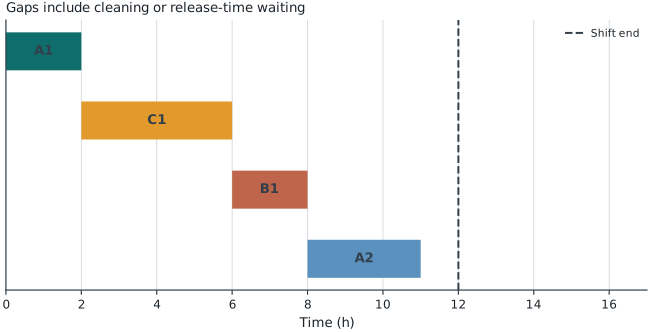
The reference objective is 11.0000 h. This value is optimal for the explicitly stated model and data.
| Job | Start (h) | Finish (h) | Tardiness (h) |
|---|---|---|---|
| A1 | 0.0000 | 2.0000 | 0.0000 |
| C1 | 2.0000 | 6.0000 | 0.0000 |
| B1 | 6.0000 | 8.0000 | 1.0000 |
| A2 | 8.0000 | 11.0000 | 0.0000 |
| Quantity | Value |
|---|---|
| Sequence | A1 > C1 > B1 > A2 |
| Makespan (h) | 11.0000 |
| Cleaning (h) | 0.0000 |
10.4.1 Check your solution
Enumerate all 24 permutations. For each one, place every job at its earliest feasible start and calculate makespan. Check that processing intervals do not overlap.
The automated residual, bound, and integrality audit passed with a maximum violation of 1.00e-06 in model units. Domain-specific checks passed. Model units differ across equations, so this numerical audit does not replace dimensional analysis.
10.5 Brief Discussion
One optimal sequence is A1 > C1 > B1 > A2, with makespan 11.00 h and 0.00 h of cleaning. The makespan is 0.00 h above the idealized no-cleaning lower bound. Equivalent optimal sequences may differ across solver versions; the objective and feasibility checks are the comparison criteria.
10.5.1 Extension to investigate
Increase the release time of A2 to 10 h. Determine whether idle time becomes unavoidable and identify a sequence that attains the new lower bound.