12 Balancing late deliveries and overtime
Problem 12 | Batch Production with Sequence-Dependent Cleaning | Level 3: Open-ended challenge
12.1 Problem Statement
Four nonpreemptive batches must be processed on one vessel. The vessel is clean and available at time zero. A release time is the earliest processing start, not the earliest cleaning start. Cleaning may occur while the next batch awaits release. Initial and final cleaning times are zero.
| Job | Processing time (h) | Release (h) | Due time (h) | Tardiness charge (USD/h) |
|---|---|---|---|---|
| A1 | 2 | 0 | 6 | 4 |
| A2 | 3 | 2 | 12 | 2 |
| B1 | 2 | 1 | 7 | 5 |
| C1 | 4 | 0 | 14 | 1 |
Cleaning times depend on product family, denoted by the first letter of the job name:
| From / to | A | B | C |
|---|---|---|---|
| A | 0 | 1 | 2 |
| B | 3 | 0 | 1 |
| C | 1 | 2 | 0 |
All cleaning times are in hours. Normal shift length is 12 h. For the reference models, processing starts lie between 0 and 30 h and the final completion time between 0 and 40 h.
Your task. Use the cleaning matrix and due times. Minimize total weighted tardiness plus overtime charged at 0.5 USD/h beyond the 12 h shift. Recommend whether these penalty rates represent a defensible service policy, and propose an alternative if some due times are contractual.
12.1.1 Before you code
Can the least-cost schedule have a longer makespan than the fastest schedule? Which late delivery is most expensive per hour?
12.1.2 Deliverables
- Define decision variables, units, objective, and constraints. State which data and assumptions are fixed.
- Predict one feature of the solution and explain why it should occur.
- Build and solve a Pyomo model. Check balances and bounds independently.
- Interpret the result and investigate the follow-up question below. For an open-ended challenge, state and defend your chosen policy separately from the reference solution.
12.2 Model Formulation
Let \(x_{ij}=1\) if job \(j\) immediately follows \(i\), with dummy nodes start and end. Let \(s_j\) be processing start and \(C_{max}\) final completion. Each job has exactly one predecessor and one successor; start has one outgoing arc and end one incoming arc. There is no direct start-end arc.
For job-to-job arcs, \[s_j\ge s_i+p_i+t_{ij}-M(1-x_{ij}),\qquad s_j\ge r_j.\] For job-to-end arcs, replace \(s_j\) by \(C_{max}\) and set cleaning to zero. Use \(M=50\) h. This is sufficient because starts are at most 30 h, processing at most 4 h, and cleaning at most 3 h; a deactivated inequality is redundant. Positive processing times rule out disconnected directed cycles: summing the time inequalities around a cycle would imply a strictly positive duration is at most zero.
Introduce \(T_j\ge0\) and \(O\ge0\) with \[T_j\ge s_j+p_j-d_j,\qquad O\ge C_{max}-12.\] Minimize \[\sum_j w_jT_j+0.5O.\] Positive coefficients make tardiness and overtime tight at optimum. This is a monetary objective, not lexicographic optimization. A hard due date would instead require \(s_j+p_j\le d_j\) and could make the model infeasible.
12.3 Pyomo Implementation
The code below is the model-building portion of models/scheduling.py. The level argument selects this problem’s assumptions. Run the complete module from the source bundle to reproduce the solution, including its independent checks:
~/.venvs/optim/bin/python -m models.scheduling 3"""Single-vessel sequencing with release times and directed cleaning."""
import itertools
import pyomo.environ as pyo
from models.common import value
JOBS = ["A1", "A2", "B1", "C1"]
DURATION = {"A1": 2, "A2": 3, "B1": 2, "C1": 4} # h
RELEASE = {"A1": 0, "A2": 2, "B1": 1, "C1": 0}
DUE = {"A1": 6, "A2": 12, "B1": 7, "C1": 14}
WEIGHT = {"A1": 4, "A2": 2, "B1": 5, "C1": 1} # USD/(h of tardiness)
CLEAN = {
("A", "B"): 1,
("A", "C"): 2,
("B", "A"): 3,
("B", "C"): 1,
("C", "A"): 1,
("C", "B"): 2,
}
def cleaning(i, j, level):
return 0 if level == 1 or i == "start" or j == "end" else CLEAN.get((i[0], j[0]), 0)
def build(level):
arcs = [
(i, j)
for i in ["start"] + JOBS
for j in JOBS + ["end"]
if i != j and (i, j) != ("start", "end")
]
m = pyo.ConcreteModel(name="Batch vessel schedule")
m.J = pyo.Set(initialize=JOBS)
m.A = pyo.Set(initialize=arcs, dimen=2)
m.x = pyo.Var(m.A, domain=pyo.Binary)
m.s = pyo.Var(m.J, bounds=(0, 30))
m.finish = pyo.Var(bounds=(0, 40))
m.out = pyo.Constraint(
["start"] + JOBS,
rule=lambda m, i: sum(m.x[i, j] for a, j in m.A if a == i) == 1,
)
m.inc = pyo.Constraint(
JOBS + ["end"], rule=lambda m, j: sum(m.x[i, j] for i, b in m.A if b == j) == 1
)
m.release = pyo.Constraint(m.J, rule=lambda m, j: m.s[j] >= RELEASE[j])
m.time = pyo.ConstraintList()
for i, j in arcs:
if i == "start":
continue
target = m.finish if j == "end" else m.s[j]
m.time.add(
target
>= m.s[i] + DURATION[i] + cleaning(i, j, level) - 50 * (1 - m.x[i, j])
)
m.tardy = pyo.Var(m.J, domain=pyo.NonNegativeReals)
m.late = pyo.Constraint(
m.J, rule=lambda m, j: m.tardy[j] >= m.s[j] + DURATION[j] - DUE[j]
)
m.overtime = pyo.Var(domain=pyo.NonNegativeReals)
m.over = pyo.Constraint(expr=m.overtime >= m.finish - 12)
objective = (
m.finish
if level < 3
else sum(WEIGHT[j] * m.tardy[j] for j in m.J) + 0.5 * m.overtime
)
m.obj = pyo.Objective(expr=objective)
return mThe common solve function calls appsi_highs, checks optimal termination before loading a solution, and checks constraint residuals, bounds, and integer domains. After building the model, use:
from models.common import solve
m = solve(build(3))
12.4 Optimal Solution
The reference objective is 5.0000 USD. This value is optimal for the explicitly stated model and data.
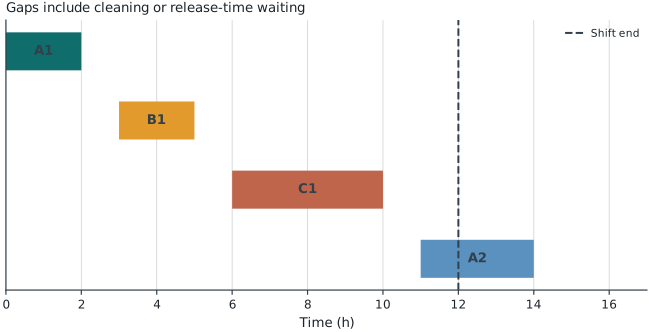
| Job | Start (h) | Finish (h) | Tardiness (h) |
|---|---|---|---|
| A1 | 0.0000 | 2.0000 | 0.0000 |
| B1 | 3.0000 | 5.0000 | 0.0000 |
| C1 | 6.0000 | 10.0000 | 0.0000 |
| A2 | 11.0000 | 14.0000 | 2.0000 |
| Quantity | Value |
|---|---|
| Sequence | A1 > B1 > C1 > A2 |
| Makespan (h) | 14.0000 |
| Cleaning (h) | 3.0000 |
12.4.1 Check your solution
Calculate tardiness from the actual finish times rather than trusting a displayed auxiliary variable. Independently enumerate all 24 sequences for the monetary objective.
The automated residual, bound, and integrality audit passed with a maximum violation of 3.55e-15 in model units. Domain-specific checks passed. Model units differ across equations, so this numerical audit does not replace dimensional analysis.
12.5 Brief Discussion
One optimal sequence is A1 > B1 > C1 > A2, with makespan 14.00 h and 3.00 h of cleaning. Total tardiness and overtime cost is 5.00 USD. The cost-optimal schedule need not be the fastest schedule. Equivalent optimal sequences may differ across solver versions; the objective and feasibility checks are the comparison criteria.
12.5.1 Extension to investigate
Sweep the overtime charge over 0, 0.5, 2, and 10 USD/h. Discuss when service and makespan objectives agree and when they conflict.