29 Order-Preserving Protein Contact-Map Comparison
Based on Protein comparison, Section 12.29 of Williams (2013). New five-residue versus six-residue contact-map instance; permits partial order-preserving matching and maximizes conserved contacts. The results below solve the stated instance and are not presented as the numerical answer to an unmodified textbook problem.
29.1 Problem Statement
Protein A has five ordered residues 1–5 and contacts (1,3), (1,4), (2,4), (3,5). Protein B has six ordered residues 1–6 and contacts (1,3), (1,5), (2,4), (3,5), (4,6). Match any subset of A residues to distinct B residues while preserving sequence order. Unmatched residues are allowed. A contact is conserved when both endpoints of an A contact map to the endpoints of a B contact. Maximize the number of conserved contacts. Extra contacts in either protein are allowed; this is not an induced-subgraph requirement.
29.2 Model Formulation
Binary \(x_{ij}\) matches residue \(i\) of A to residue \(j\) of B. Require \(\sum_jx_{ij}\le1\) and \(\sum_ix_{ij}\le1\). For \(i<k\) and \(j\ge l\), forbid crossing or reversed matches with \(x_{ij}+x_{kl}\le1\).
For each contact \((i,k)\) in A and \((j,l)\) in B, with both edges oriented in increasing order, introduce \(z_{ikjl}\in[0,1]\) and impose \(z\le x_{ij}\), \(z\le x_{kl}\), \(z\ge x_{ij}+x_{kl}-1\). Maximize \(\sum z\). Binary endpoint matches force exact conserved-edge indicators. Partial matching permits deletions or insertions while the ordering constraints preserve the sequence.
All decision variables and units refer to the problem statement above. Continuous variables are nonnegative unless explicitly stated otherwise; binary and integer domains are specified in the equations and code.
29.3 Pyomo Implementation
The following Python implementation uses Pyomo and HiGHS. Run from the workbook root so that the models package and shared helpers are importable. The shared solver and audit functions check optimal termination before loading values, then verify every active constraint, variable bound, and integer domain. Any imported earlier-chapter model supplies the data and balances already explained there.
The full source is problem29.py. To solve and print this problem independently:
~/.venvs/optim/bin/python -m models.common 29import itertools
import pyomo.environ as pyo
from models.common import frame
EA = [(0, 2), (0, 3), (1, 3), (2, 4)]
EB = [(0, 2), (0, 4), (1, 3), (2, 4), (3, 5)]
def build():
m = pyo.ConcreteModel()
m.I = pyo.RangeSet(0, 4)
m.J = pyo.RangeSet(0, 5)
keys = [(i, k, j, l) for i, k in EA for j, l in EB]
m.x = pyo.Var(m.I, m.J, domain=pyo.Binary)
m.z = pyo.Var(keys, bounds=(0, 1))
m.c = pyo.ConstraintList()
for i in m.I:
m.c.add(sum(m.x[i, j] for j in m.J) <= 1)
for j in m.J:
m.c.add(sum(m.x[i, j] for i in m.I) <= 1)
for i, k in itertools.combinations(m.I, 2):
for j in m.J:
for l in m.J:
if j >= l:
m.c.add(m.x[i, j] + m.x[k, l] <= 1)
for i, k, j, l in keys:
m.c.add(m.z[i, k, j, l] <= m.x[i, j])
m.c.add(m.z[i, k, j, l] <= m.x[k, l])
m.c.add(m.z[i, k, j, l] >= m.x[i, j] + m.x[k, l] - 1)
m.obj = pyo.Objective(expr=sum(m.z[key] for key in keys), sense=pyo.maximize)
return m
def alignment(m):
return {i: j for i in m.I for j in m.J if pyo.value(m.x[i, j]) > 0.5}
def check(m):
best = 0
for size in range(6):
for aa in itertools.combinations(range(5), size):
for bb in itertools.combinations(range(6), size):
mapping = dict(zip(aa, bb))
best = max(
best,
sum(
i in mapping and k in mapping and (mapping[i], mapping[k]) in EB
for i, k in EA
),
)
mapping = alignment(m)
assert all(
mapping[i] < mapping[k] for i, k in itertools.combinations(sorted(mapping), 2)
)
assert abs(pyo.value(m.obj) - best) < 1e-6
def tables(m):
a = alignment(m)
return {
"alignment": frame(
[[i + 1, j + 1] for i, j in a.items()], ["Residue in A", "Residue in B"]
),
"conserved": frame(
[
[i + 1, k + 1, a[i] + 1, a[k] + 1]
for i, k in EA
if i in a and k in a and (a[i], a[k]) in EB
],
["A start", "A end", "B start", "B end"],
),
}
def plot(m):
a = alignment(m)
return (
["A contacts", "B contacts", "Conserved contacts"],
[len(EA), len(EB), pyo.value(m.obj)],
"Contact edges",
)
# Solve, audit constraints, and run domain-specific checks.
from models.common import solve, audit
model = solve(build())
audit(model)
check(model)
for name, result_table in tables(model).items():
print(name)
print(result_table.to_string(index=False))29.4 Optimal Solution
The solver reports optimal termination. The objective is 3 conserved contact edges (maximize). The largest violation across active constraints, variable bounds, and integer domains is 1.11e-16 in the corresponding model units. The problem-specific checks also pass. These checks establish numerical consistency with the stated model, not the validity of its assumptions for a real facility.
29.4.1 Alignment
| Residue in A | Residue in B |
|---|---|
| 1 | 2 |
| 2 | 3 |
| 3 | 4 |
| 4 | 5 |
| 5 | 6 |
29.4.2 Conserved
| A start | A end | B start | B end |
|---|---|---|---|
| 1 | 3 | 2 | 4 |
| 2 | 4 | 3 | 5 |
| 3 | 5 | 4 | 6 |
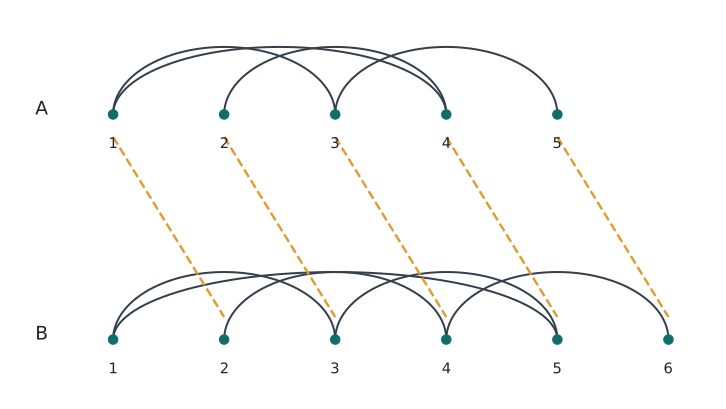
Tables round numerical values for reading; feasibility checks use the original solver values. Multiple optimal decisions may exist. Machine-readable result records the solver status and package versions. Figure-generation code is in figures/workbook.py.
29.5 Brief Discussion
The alignment conserves 3 of the 4 contacts in protein A. Unconserved and extra contacts are allowed by the stated matching objective.
Matching many residues is different from preserving many contacts. The objective gives no reward for an isolated matched residue, so equally optimal alignments may differ in their unmatched positions. A secondary objective could maximize matched residues after fixing the best contact score. Experiment: remove order preservation and assess how much the score improves at the cost of losing a sequence-consistent interpretation.